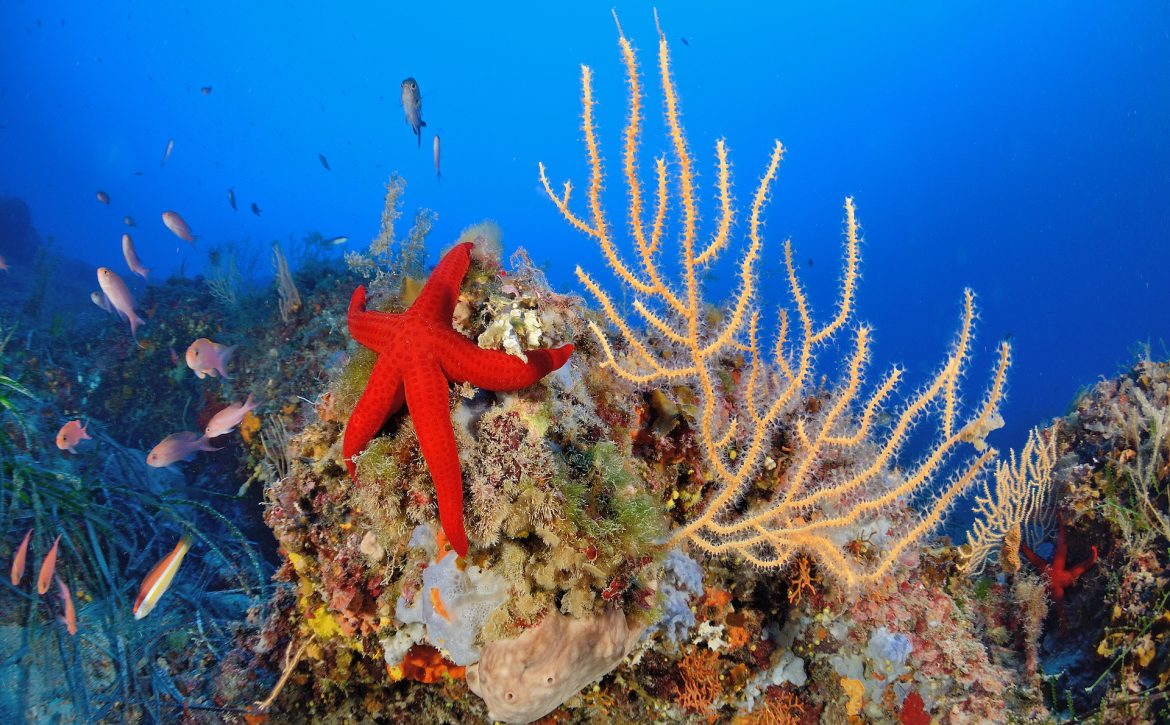
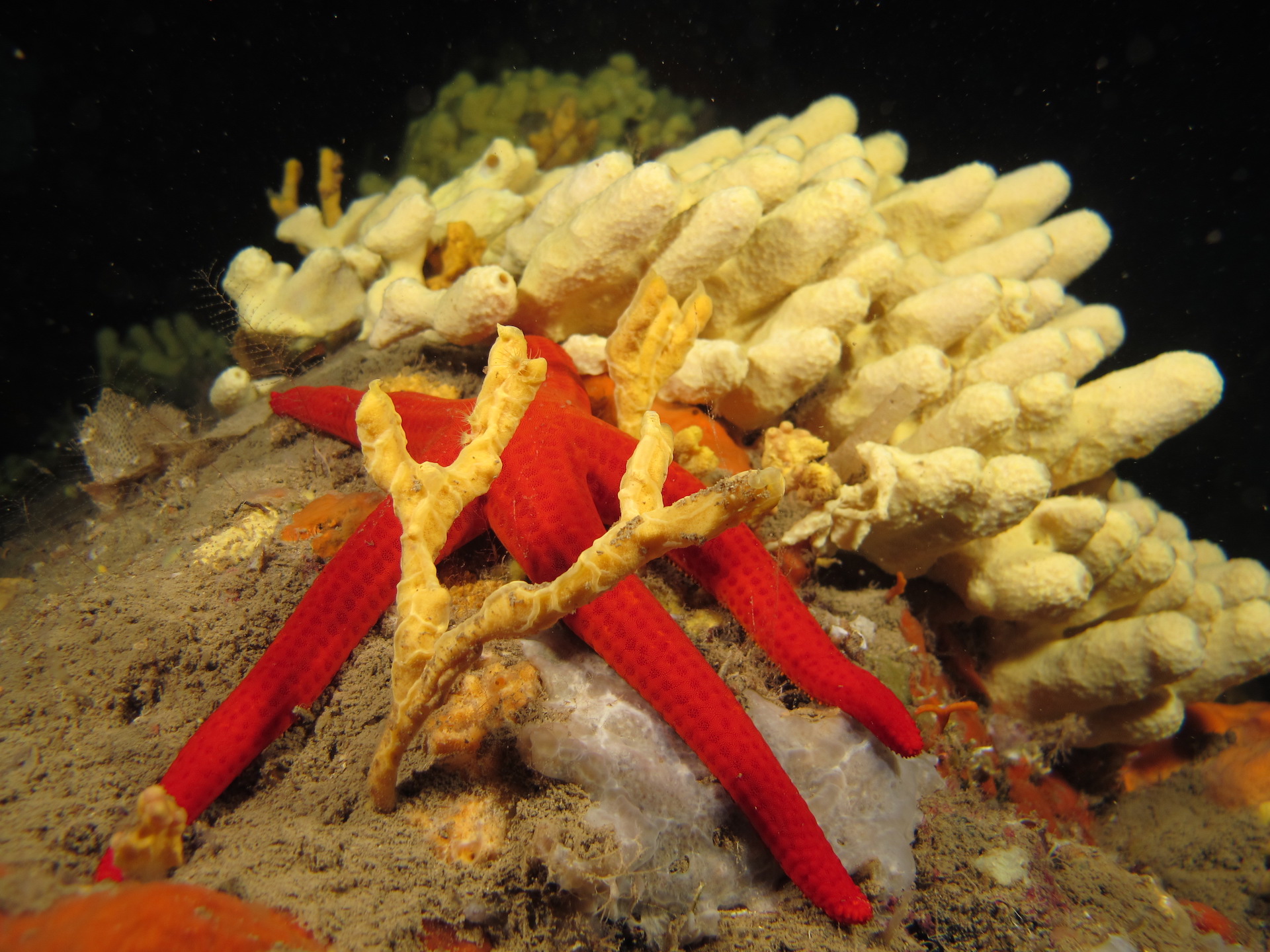
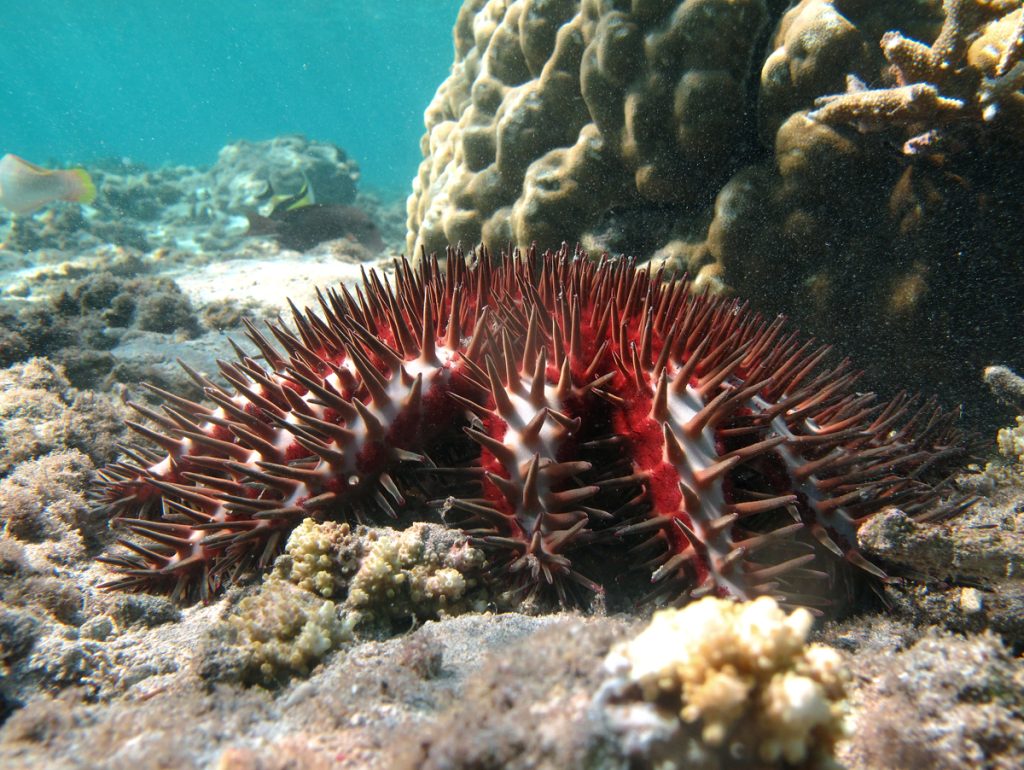
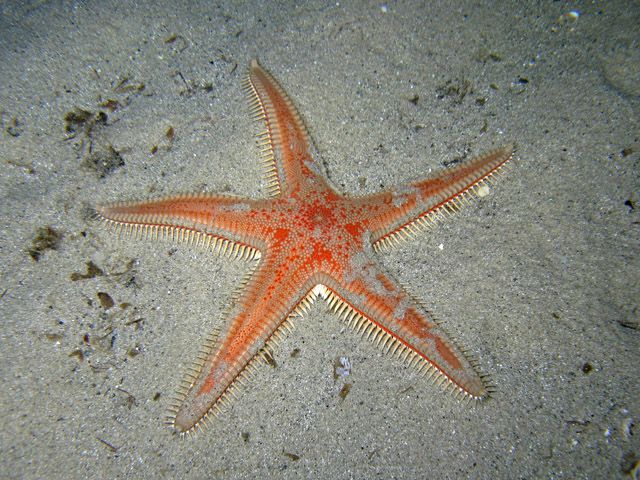
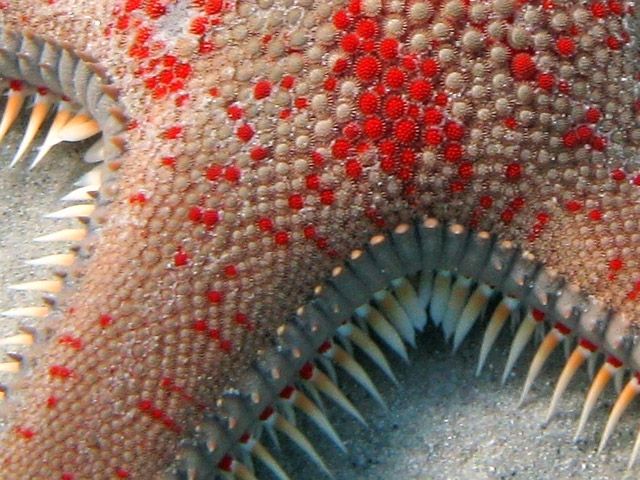
It lives on soft seabeds: mud, sand, and gravel. Although it prefers sandy Mediterranean bottoms from the surface down to 100 meters in depth, it is relatively easy to encounter near Posidonia oceanica seagrass meadows. It is unmistakable for the large size it can reach (up to 50 cm), its red-orange color, and the presence of spines along all the marginal plates. Its smoother appearance compared to stars living on rocky bottoms is due to the presence of table-shaped ossicles (calcareous plates) that protect the papulae covering the aboral surface (the side opposite the mouth — the one we observe from above). These papulae play an important role in gas exchange and waste elimination, functions that could otherwise be hindered by sand and mud. Moreover, to move across soft substrates, they have tube feet without suction cups, which instead of attaching to the surface act like small anchor pegs, allowing movement by traction.
A small digression…
Stars of the genus Astropecten bring back memories of my dive guide and instructor courses where, striving for perfect execution, during long sessions in shallow sandy waters, we repeated Open Water and Rescue course skills. After a while, as we kept stirring up the sand, these little 5–10 cm stars would begin to emerge, moving away looking slightly offended at being disturbed. You have no idea how many scoldings I got for getting distracted watching them 😀
Back to sea stars
Sea stars are mostly carnivorous. Their prey consists of sessile, slow-moving, or dead animals, which means their hunting method does not require great speed. They are nevertheless relentless predators that devour their prey by gripping it with their strong arms and then calmly consuming it. Some species, especially those feeding mainly on bivalve mollusks, are able to evert their stomach outside their body. This “hunt” happens so slowly that, even if you witness it during a dive, it often goes unnoticed… but try imagining it with the commentary of a documentary about great predators… can you hear the suspenseful music starting?
Imagine…
…an unsuspecting mussel or oyster peacefully filtering water in search of food when… suddenly, it is seized by something attempting to pry open its shells, leveraging powerful arms that adhere to its surface with strong suction cups. The poor mollusk closes with all its strength. A terrible tug-of-war begins between the two animals fighting for survival (because yes, if the sea star cannot feed, it too will eventually die). Until… the mollusk gives in ever so slightly, opening by just 0.1 mm — but that is enough for the sea star’s everted stomach to slip inside the shell and attack the adductor muscle (the one responsible for keeping the shells closed). At this point, the battle is won. The protection of the shell fails, and the sea star can calmly feed, pulling pieces of the mollusk inside itself while retracting its stomach.
Exceptional abilities
I bet that now the little “starfish” doesn’t seem quite so cute anymore and is starting to resemble an alien monster like the Blob.
The similarities to a creature from another planet do not end here, because this ruthless predator is also capable of regeneration! Not only can it regenerate an arm if it loses one due to an accident — few predators feed on them; they are mainly victims of parasites — but if, along with the arm, a portion of the central disc detaches, an entirely new individual can grow from it!
Water vascular system
To conclude, I’d like to leave you with this short video, recorded in an aquarium, showing the fascinating locomotion system of the sea star. It is made possible by a complex hydraulic system composed of ampullae, tube feet, and suction cups, all connected through the water vascular system. This consists of a network of canals that branch out from a central ring through the arms, transporting a fluid similar to seawater that also functions in gas exchange, nutrient transport, and the elimination of metabolic waste such as ammonia (although these processes are also supported by the papulae and the hemal system).
The water vascular system connects to the outside through a kind of sieve-like plate located on the aboral side (opposite the mouth) of the star — specifically, the usually lighter-colored spot found on the central disc, slightly off-center. If the starfish is taken out of the water, even for a short time, small gas bubbles can enter the water vascular system, compromising its function and consequently its mobility, ultimately condemning it to starve. For this reason… no photos of sea stars out of the water — and if you see someone doing it, explain why it’s wrong!
I hope that from now on you will look at these animals with different eyes. Jokes aside, they truly are adorable. Maybe… you might feel a shiver imagining a giant sea star arriving from outer space… but until then, rest easy 😉
If you are interested in learning more about echinoderms, below you will find a link to a PowerPoint lecture from the University of Rome, as well as the references of the books I used to write this post. If you have specific questions, curiosities, or doubts, feel free to write in the comments!
“Zoology” – Robert L. Dorit, Warren F. Walker Jr., Robert D. Barnes
“Mediterranean Sea Fauna and Flora” – Rupert Riedl
http://www.federica.unina.it/smfn/zoologia/phylum-echinodermata/