OLYMPUS DIGITAL CAMERA

Fantastic creatures and where to find them – scuba diving edition: Bonellia viridis

There are marine organisms that everyone knows — if not because they have seen them while diving, then certainly because they have bought them at the supermarket or ordered them at a restaurant… and then there is the vast multitude that no one knows, because they are small, not very colorful, and of no commercial interest.

This large portion of animals and plants is almost always ignored, even by the most experienced divers. But to those who choose to take an interest in them, they can reveal incredible stories that will never again allow them to finish a dive saying the sad phrase, “I didn’t see anything.”

Bonellia viridis
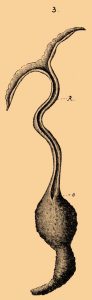
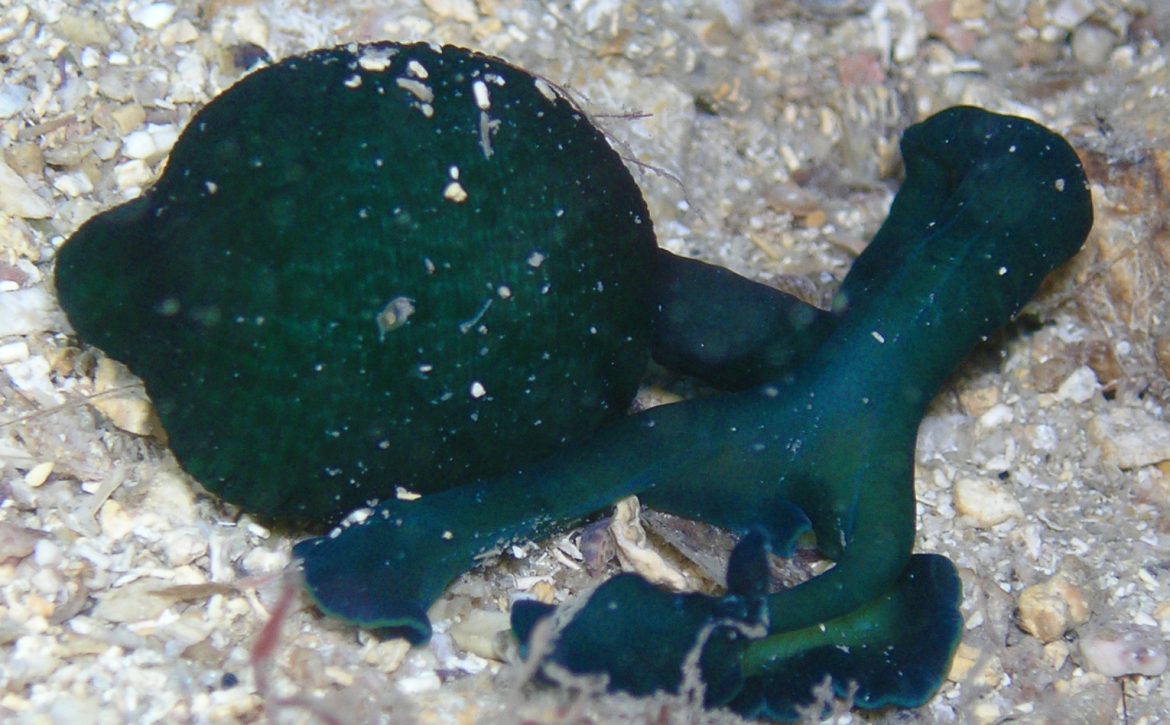
It emerges from between the rocks like a thin green-brown filament, which at first glance could be mistaken for algae, ending in a slightly wavy T-shape. This is generally the only visible part of Bonellia viridis, and it is its proboscis, which it uses to probe the substrate and collect small organisms or organic fragments that make up its food. If touched (always with proper care), the proboscis retracts toward the body quite quickly. The body itself is hidden inside cavities between the rocks and has a rounded shape.
The area where it is easiest to spot it is where a rocky wall meets a sandy bottom, since the proboscis stretches out over the flat surface in search of food and is therefore clearly visible. Personally, the largest specimens I have ever seen were on the seabed at Le Cannelle (a dive site near Porto Azzurro), but individuals of all sizes can be found on almost every dive (usually between 10 and 100 meters deep on hard substrates where they find shelter).
So far nothing unusual and all rather boring… but now comes the interesting part: everything we have described so far is always and exclusively a female Bonellia! The male, in fact, is only a few millimeters long and lives first in the proboscis and later near the female’s genital organs, parasitizing her. Usually, when we guides tell this story during a debriefing, at this point comments start pouring in, varying depending on whether the audience is mostly male or female. Generally, men express approval of the male Bonellia’s lifestyle and its strategically advantageous position, while women claim they find nothing strange about it since it works that way for Homo sapiens too. Meanwhile, B. viridis doesn’t care about any of these gender debates, since whether male or female, its life will always be confined to a hole, collecting crumbs just to survive.
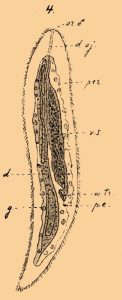
The other “strange” fact about this rather sedentary organism concerns how sex determination occurs. It is one of the few cases of phenotypic sex determination, meaning it depends on environmental factors. B. viridis is born as a “cherub” (asexual) and spends the first part of its life as a trochophore larva (a top-shaped larva equipped with cilia that allow small movements), swimming freely and happily in the sea. Not so peacefully, because if lucky, it will risk many times becoming someone’s lunch or dinner, and if unlucky, it will end its life still asexual inside someone’s stomach. It swims and swims, and when the time comes, if it is sucked in by a female’s proboscis, it will become a male; otherwise, it will become a female. This happens because adult females contain a green pigment called bonellin, which induces masculinization in the larvae. In the absence of this substance, almost all larvae become females. Some larvae, however, appear to be resistant to the effects of bonellin and tend to express male or female characteristics regardless of its presence, producing intersex individuals — in short, true rebels!

Sexual dimorphism in B. viridis: the female is significantly larger than the male of the species. In fact, she can measure from 10 cm up to 1 meter in length (including the proboscis), while the male is only a few millimeters long.
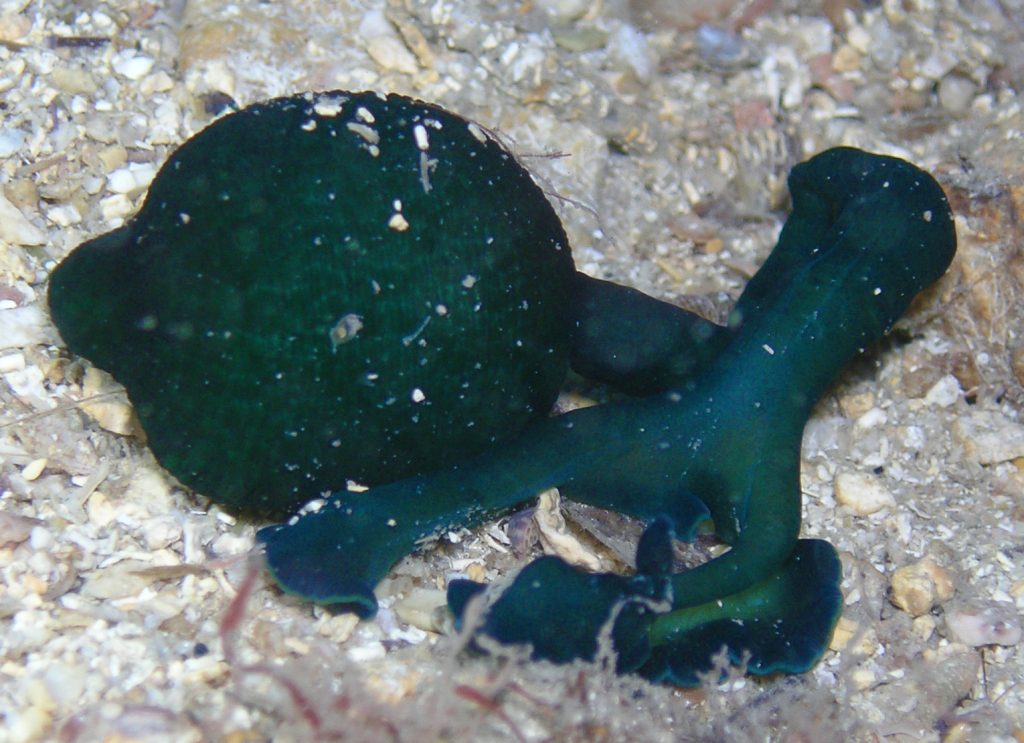
Bonellin is also responsible for the intense green color of B. viridis, a rather unusual feature even for a marine animal, and the cause of its toxicity. Yes… this nice and apparently harmless little creature is actually highly poisonous!
Present both in the proboscis and in the skin of B. viridis, bonellin is a chlorine-based molecule similar to chlorophyll, although it is not related to it (even if early studies hypothesized that B. viridis derived it from chlorophyll obtained through feeding). At this point in the story, B. viridis turns into a “ruthless killer”… extremely low concentrations of its green pigment are enough to produce toxic effects, and this substance penetrates tissues rapidly, accelerating its action. Thanks to this pigment, B. viridis, despite living in environments potentially rich in encrusting organisms, is completely free of them. But its “ruthlessness” does not stop here: again thanks to bonellin, it can block the development of echinoderm and ascidian embryos, and it also causes cellular dissociation in sponges. Now we enter true “splatter” territory, because when brought into contact with blood, bonellin causes hemolysis. This pigment also becomes much more active in the presence of light.
So from now on, when you see that shy proboscis emerging from beneath a rock, remember that you are facing an animal full of surprises.
For those who would like to explore further, below are some links and sources I consulted while writing this article, all freely accessible online.
Bonellia viridis
Information accessible via Google Books: “Comparative Biochemistry: A Comprehensive Treatise, Volume IV: Constituents of Life — Part B focuses on the distribution, biogenesis, and metabolism of cells and organisms”, p. 587 Bioorganic Marine Chemistry, Volume 1, Springer Science & Business Media, Dec 6, 2012, pp. 81 and 155 “Polychaetes & Allies: The Southern Synthesis” by Australian Biological Resources Study, Csiro Publishing, 2000, pp. 354–358, 361–362, 368, 369